The Forsyth County Office of Environmental Assistance and Protection enforces Federal and Local regulations governing gasoline-dispensing facilities. These regulations ensure that gasoline vapors containing ozone-producing organic compounds and air toxics, many of them carcinogens, are properly contained within a Stage 1 Vapor Recovery System engineered into the design of the facility. We register and inspect over 200 stations throughout Forsyth County.
The information below will assist facility owners in complying with federal and local regulations.
- What does a Stage 1 Vapor Recovery System do?
- Who is required to register?
- Who must comply with federal rules?
- When do gasoline-dispensing facilities have to comply with federal rules (NESHAP)?
- What is “reconstruction”?
Forms and Other Information For Owners\Operators of Gasoline-Dispensing Facilities
- Registration Forms - formats available = MS Word™ and Adobe Reader(pdf)
- Registration Form Instructions – Adobe Reader(pdf)
- Compliance Categories – includes requirements based on facility throughput of gasoline
What does a Stage 1 Vapor Recovery System do?
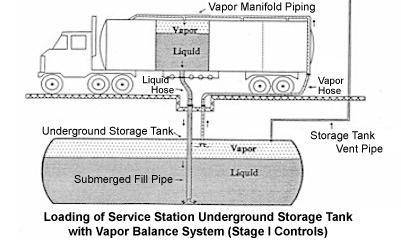
A Stage 1 Vapor Recovery System prevents the release of gasoline vapor emissions while liquid is being transferred from the cargo tanks to the underground storage tanks. Gasoline vapors contain air toxics, some of which are carcinogenic (e.g. benzene). They also contain volatile organic compounds that contribute to the production of ozone. Ozone produced in the lower levels of the atmosphere causes health problems, damage to vegetation, and the physical deterioration of man-made structures and finishes.
Who is Required to Register?
In Forsyth County, all Gasoline Dispensing Facilities (GDFs) with annual throughputs of greater than 50,000 gallons of gasoline per year, or those who do not have permanently equipped submerged fill pipes are required to register with the Forsyth County Office of Environmental Assistance and Protection. New GDFs that project annual throughput of greater than 50,000 gallons of gasoline per year are also required to register. These facilities are required to install Stage 1 vapor recovery systems in accordance with rule 3D .0928 of the Forsyth County Air Quality Code (FCAQC) entitled Gasoline Service Stations Stage 1. In addition to this rule, the Forsyth County Air Quality Code adopts by reference (see rule 3D .1111 of the code) the National Emissions Standards for Hazardous Air Pollutants that includes 40 CFR Part 63, Subpart CCCCCC — National Emission Standards for Hazardous Air Pollutants (NESHAP) for Source Category: Gasoline Dispensing Facilities.
Who must comply with federal rules (NESHAP)?
On January 10, 2008, U.S. EPA published 40 CFR Part 63, Subpart CCCCCC — National Emission Standards for Hazardous Air Pollutants for Source Category: Gasoline Dispensing Facilities as a final rule. These rules affect all gasoline dispensing stations except major facilities subject to Title V permitting. The rules are separated into three compliance categories based on throughput of gasoline (excluding aviation gasoline storage tanks at airports). They are:
- Facilities with monthly throughputs less than 10,000 gallons (These requirements also apply to tanks with capacities of less than 250 gallons at all facilities, regardless of throughput).
- Facilities with monthly throughputs of 10,000 gallons or more.
- Facilities with monthly throughputs of 100,000 gallons or more.
For more information on the three compliance categories, click here.
When do gasoline dispensing facilities have to comply with federal rules (NESHAP)?
- A gasoline dispensing facility that commenced construction or reconstruction after November 9, 2006 must comply with the applicable requirements by January 10, 2008.
- A gasoline dispensing facility that commenced construction or reconstruction after January 10, 2008 must be in compliance with the applicable requirements upon startup.
- All gasoline dispensing facilities that commenced construction on or before November 9, 2006 must comply with the applicable requirements no later than January 10, 2011.
If you have a facility that commenced construction before November 9, 2006 that becomes subject to more stringent requirements because of an increase in the average monthly throughput, you must comply with the more stringent requirements no later than 3 years after the date that it becomes subject to these requirements.
What is "Reconstruction"?
Reconstruction, unless otherwise defined in a relevant standard, means the replacement of components of an affected or a previously nonaffected source to such an extent that:
- The fixed capital cost of the new components exceeds 50 percent of the fixed capital cost that would be required to construct a comparable new source; and
- It is technologically and economically feasible for the reconstructed source to meet the relevant standard(s) established by the Administrator (or a State) pursuant to section 112 of the Act. Upon reconstruction, an affected source, or a stationary source that becomes an affected source, is subject to relevant standards for new sources, including compliance dates, irrespective of any change in emissions of hazardous air pollutants from that source.





County Services